
Criminal Cases in the Goliad County Courts
Goliad County divides criminal cases by charge level and place. The 24th, 135th, and 267th Judicial District Courts exercise general jurisdiction and can hear felony cases. The constitutional Goliad County Court handles its statutory misdemeanor work. Goliad County has no County Court at Law. The City of Goliad Municipal Court and Justice Courts in Precincts 1 and 2 keep their own fine-only matters and criminal process. A search limited to one court can therefore miss a valid case held at another level.
The combined Goliad County and District Clerk keeps the district and constitutional county-court files. Its counter is at 127 N. Courthouse Square, Goliad, Texas 77963. Call 361-645-3294 or mail a request to P.O. Box 50, Goliad, TX 77963. Effective June 1, 2026, posted weekday hours are 7:00 a.m. to 5:30 p.m., with a noon closure from 12:00 to 12:30 p.m. Monetary transactions stop after 5:00 p.m. Confirm hours before a visit.
Which Goliad Court Has the Case?
The charge class is the best first clue. A felony case belongs in a Goliad County district court, while a Class A or Class B misdemeanor ordinarily points to the constitutional county court. Fine-only city cases and ordinance matters may remain at Municipal Court. A justice court can hold its own fine-only matter or magistrate process. This split also explains why a person may find a related event at one level but not the whole record.
| Court | Criminal case slice | Official route |
|---|---|---|
| 24th, 135th, or 267th District Court | Felonies and general-jurisdiction matters | Combined clerk, 361-645-3294 |
| Goliad County Court | Statutory misdemeanor jurisdiction | Combined clerk at the courthouse |
| City Municipal Court | Fine-only city and ordinance cases | 152 W. End St., 361-645-3454 |
| Justice Court Precinct 1 or 2 | Fine-only cases and magistrate process | JP 1 or JP 2 |
A district judge may maintain an administrative office outside Goliad because these courts serve more than one county. The Goliad case record still remains with the combined clerk. Court location and file custody are not the same question.
How to Search Case Records
Begin with the Goliad Public Search link on the clerk page. Its vendor interface may change, so inspect the live fields before relying on a saved path. A case number is the strongest key. If none is known, use the full legal name, test former names or spelling variants, and widen the filing dates.
The research captured the local interface only in part. Confirm the current controls, result limits, and document access in the live search. Call the clerk when a result is absent, incomplete, or too old for the online index.
- Open the clerk's official page and follow its Goliad Public Search link.
- Select the likely district or county court and criminal case type.
- Search by case number when possible, or use the full name and a broad date range.
- Read the register of actions and separate filed, pending, and disposed entries.
- Ask the clerk for the signed judgment, dismissal, or certified copy needed to confirm the result.
| Field to Verify | Likely Type | Live Status | Use |
|---|---|---|---|
| Name | Text | Verify live | Try full legal and known former names |
| Case number | Text | Verify live | Best direct identifier when known |
| Court | Selector | Verify live | Choose district or county level if offered |
| Date range | Date controls | Verify live | Broaden when the filing year is uncertain |
| Case type or status | Possible selector | Verify live | Narrow only after a broad search |
Goliad County Criminal Case Search
re:SearchTX provides a statewide electronic court-record platform, but it should be a second check for Goliad County criminal case records. Texas Judicial Council material has historically described public coverage in terms that do not promise a complete statewide criminal database. A blank state result does not prove that the combined clerk has no local file.
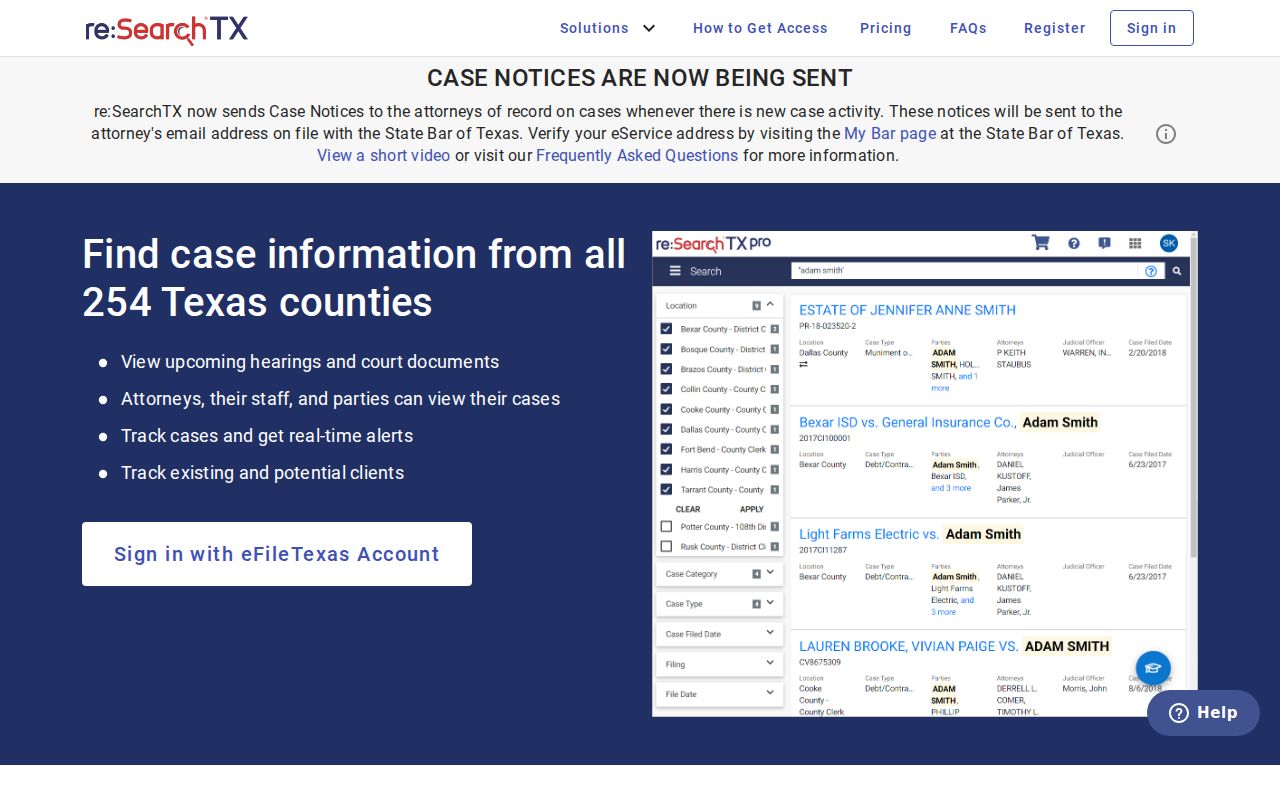
The portal view shows why a remote search can help locate electronic material while still leaving the signed local order as the sound source for a Goliad County outcome. If both portals fail, phone, mail, and an in-person counter request remain available.
County and District Clerk
127 N. Courthouse Square
Goliad, TX 77963
Mail: P.O. Box 50
361-645-3294
What the Case File Shows
A Goliad County court file centers on the prosecution, not the jail intake. The docket should identify the court and case, the filed accusation, settings, motions, pleas, rulings, and final orders. Look past a short status label. The signed judgment or dismissal is stronger proof of the outcome, and it may resolve shorthand or stale data in a search summary.
| Case Number & Court | Identifies the file and the Goliad County court that owns it. |
|---|---|
| Charging Document | Shows the complaint, information, or indictment filed for prosecution. |
| Docket Entries | Lists filings, settings, motions, notices, and orders by date. |
| Hearing Dates | Records scheduled or completed court appearances. |
| Disposition & Judgment | States dismissal, acquittal, conviction, or another charge outcome. |
| Sentence & Conditions | Shows punishment, costs, restitution, or community-supervision terms when ordered. |
Bond, warrant, attorney, appellate, and document entries may also appear. Protected identity data, victim or minor information, and sealed material should be absent or redacted.
Reading Goliad Criminal Court Outcomes
Three fields answer different questions. The charge is the accusation filed in court. The disposition is the result of that charge. The judgment is the signed instrument that states the court's ruling and, after conviction, may include the sentence. A day-one arrest label can differ from the final filed or adjudged offense, so it should not be used as a substitute for the Goliad County case file.
- Disposition
- The outcome of a charge or case.
- Nolle prosequi
- The prosecutor's formal choice not to continue a charge.
- Deferred adjudication
- Community supervision without an immediate finding of guilt, subject to later dismissal or adjudication.
- Capias
- A court-issued writ ordering arrest, often after a procedural default or judgment.
The 24th Judicial District Attorney screens and prosecutes matters within its authority, but the prosecutor's working file is not the clerk's public court record. The official page lists the office at 307 N. Gonzales St. in Cuero and provides a Goliad victim-assistance contact.
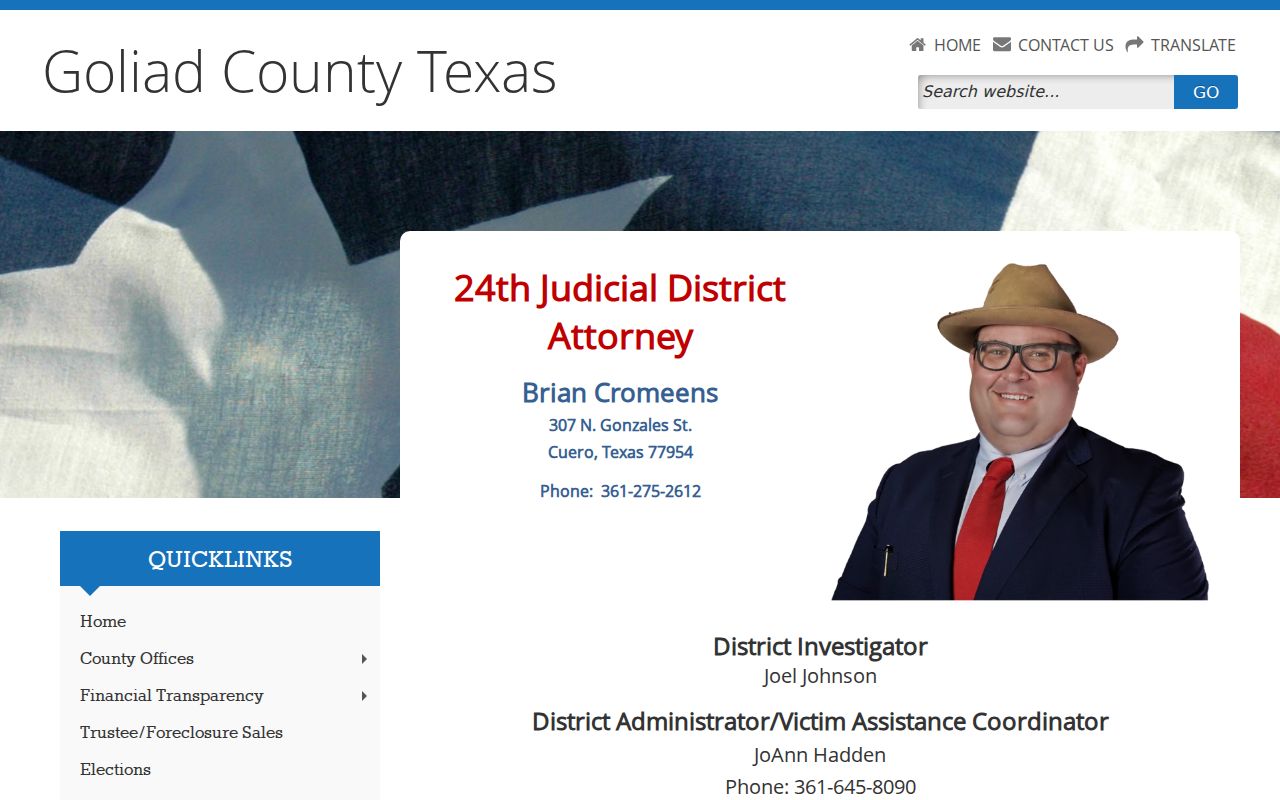
The office page helps identify the prosecutor and victim-assistance route, while the combined clerk remains the custodian for the docket and signed court orders.
Stages of a Criminal Case
A Goliad County criminal case begins in the court record when a complaint, information, or indictment is filed or advances the prosecution. Arraignment addresses the accusation and plea. Pretrial activity can add motions, settings, discovery-related orders, bond rulings, or negotiated filings. The matter then moves to a plea or trial, followed by the disposition and, when there is a conviction, sentencing.
Case flow: Charges Filed › Arraignment › Pretrial › Plea or Trial › Disposition › Sentencing
The clerk's register of actions is the time line for these events. A setting is not proof that a hearing occurred, and a plea entry is not always the final judgment. Read the later signed order before stating how the case ended.
For wider context on how the filed case fits with local arrest and repository records, the Goliad Criminal History page separates those record systems.
Archived Goliad Criminal Case Files
When an older Goliad County criminal case does not appear online, give the clerk a full name, approximate filing year, likely court, charge, and case number if known. Ask whether the file is paper, archived, or simply not available through the vendor screen. A middle-name mismatch, hyphenation, former name, wrong court level, or narrow date range can also hide a valid index entry.
Request the register of actions first, then name the exact instrument needed. A plain copy may be enough for research, while a certified judgment or dismissal may be needed when the record must carry the clerk's certification. Goliad County has not posted a stable local fee for plain or certified criminal copies in the research sources, so ask for the current amount and delivery options before ordering. Mail and in-person requests provide a fallback when remote document access is not available.
Note: A missing portal result is a reason to check another court or ask the clerk, not proof that no Goliad County file exists.
Access & Restrictions
Texas court files use a judicial-record access framework, with the clerk serving as custodian. That route differs from a Texas Public Information Act request for a sheriff's offense report. Texas court rules and standards address judicial records, while Government Code Chapter 552 governs many agency records. Sending a TPIA request to the sheriff will not make that office produce the clerk's judgment.
If an online result and the paper record conflict, ask for the signed Goliad County order. A dismissal does not by itself erase every arrest or booking record, and a nondisclosure order restricts public release without acting as full destruction. Government Code Chapter 411 governs criminal-history dissemination and nondisclosure, while Code of Criminal Procedure Chapter 55A governs expunction.
Federal case access uses a different court system. Goliad County lies in the Southern District of Texas, and PACER is the official federal docket and document portal after account registration.
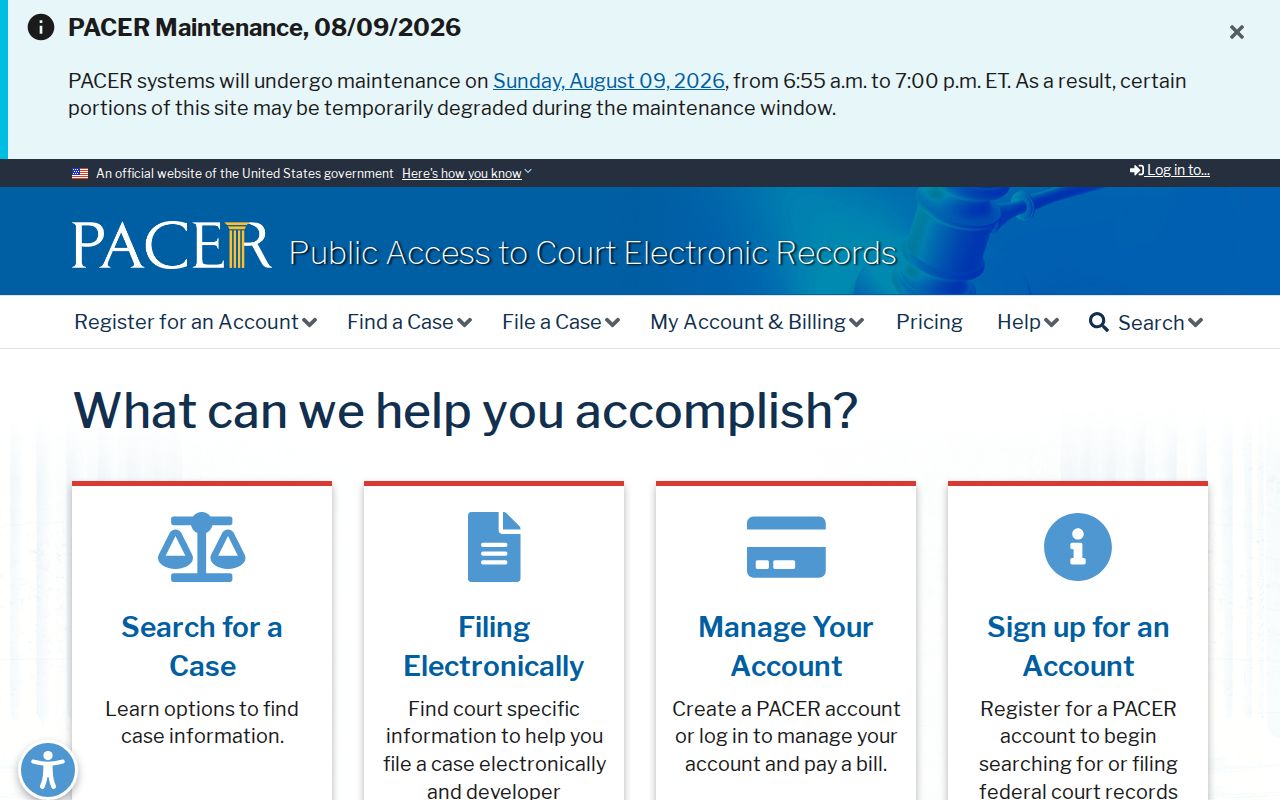
The PACER screen marks that separate federal route. It does not replace Goliad Public Search, the combined clerk, Municipal Court, or the Justice Courts.
Goliad District Court Felony Degrees
Texas felony labels help identify why a Goliad County matter belongs in district court, but they do not state the outcome. Capital, first-degree, second-degree, third-degree, and state-jail felonies each have an ordinary punishment range under Texas Penal Code Chapter 12. Enhancements and offense-specific laws can change those ranges. Read the filed instrument for the prosecuted level and the signed judgment for the offense of conviction.
A booking entry may show the arresting officer's first charge label. Prosecutor screening, a grand-jury decision, an amended filing, or a plea can alter the Goliad criminal court charge later. A state-jail felony still belongs in district court despite the word “jail,” while Class A and Class B misdemeanors ordinarily point to Goliad County Court. Fine-only Class C cases may be held by Municipal or Justice Court.
Use the final Goliad judgment rather than inferring guilt or punishment from a charge class. That one document ties the offense level to the actual disposition and sentence.